
How the
Alexander Technique Works to help you to Loosen Up
Alexander Technique PlymouthFree Introduction
David Owen +44 1752 361576 or 07791 930028
Over 35 years experience
View from Table Cape near Wynyard, Tasmania: Alexander’s birthplace in 1869.
The Beginnings
The Alexander Technique was developed over many years by an actor and reciter, born in Tasmania in 1869 called Frederick Matthias Alexander.
He was especially popular for his one man touring shows around Australia and New Zealand, where he would recite extracts from Shakespeare as well as interesting and comedic stories. Unfortunately he developed problems with his voice, to the point where sometimes, he would even lose it during a performance.
According to Alexander’s account, he consulted various doctors, and after one had prescribed rest and gargles, his voice improved. However, as soon as he went back to reciting, he rapidly lost his voice again. On returning to the doctor, the doctor accused him of not keeping to his programme properly. However, Alexander objected that he had been very rigorous, but deduced that seeing as the problem had returned when he started reciting again, that:
“It was something I was doing –
in using my voice
that was the cause of the trouble.”
.
(The Use of the Self F. M. Alexander. Ch 1 ‘The evolution of a technique’ Par 9.)
The doctor agreed that it must be so, but could not say what Alexander may have been doing to cause it.
Alexander therefore studied himself in multiple mirrors from different angles while reciting and also when not reciting. He eventually noticed that he was distorting his larynx by pulling his head back while he recited.
His Discovery and Solution
When Alexander started observing himself, he noticed that he habitually pulled his head back when he recited. However, after a while, he noticed that he did this even when he was about to recite. As mentioned, this is what was distorting his larynx. He tried putting his head forward instead, but found it went forward and down, so he tried putting it forward and up. This improved his larynx and voice while he was able to maintain it, but his habits were so strong that he was rarely able to maintain it without a mirror. In fact he didn’t even realise he had reverted to his old habit!
In order to avoid triggering his habits in the first place, he found he had to:
.
-
-
- Inhibit (or put aside) his desire to recite in the first place
- Instead, without actually deliberately doing it, he would direct his head to go forward and up to counter pulling it back and to counter it going down when it went forward. In other words, he would think of his head going this way. This was necessary in order to get himself into a condition where he could recite without distorting himself. Once he had achieved and maintained this-
- He would then spontaneously choose to either:
Do nothing, except continue to maintain this good condition-
Do something else instead of recite-
Or actually go ahead and recite anyway.
-
This way, he circumvented any habitual preparation to recite and was able to do so without distorting his larynx and consequently without losing his voice!

A red traffic light–
We all know how to inhibit our imediate desires when it is appropriate.
Principles
He called these procedures and principles Inhibition, Direction and Conscious Choice and they are at the core of the technique. More precisely:
Inhibition, Direction and Conscious Choice
-
-
- Inhibition– Is being able to refrain from doing what we would normally do under a particular set of circumstances. We do not have true choice or the ability to change what we do to improve our lives, unless we can cease doing what we would ordinarily have done. This extends to all areas of our lives.
- Direction– The ability to bring about changes, primarily in our bodies, but ultimately throughout our lives, just by thinking of the condition we want. Alexander described improving the alignment of his head, neck and body by directing his head forward and up without moving it directly. This is a thinking process, as described in the thinking experiment on the home page. I use the specific process in this experiment, as a universal way to both reduce background tension and to bring about optimum, natural head, neck and body alignment.
- Conscious Choice– We need to have alternatives to our original intention, in order to avoid the habits that come from only anticipating one intention. There are always only three possibilities: Do nothing, except maintain optimum condition, do something other than your original intention, or fulfil your original intention afterall. In practice, we can develop a continuing state of openness to whatever is appropriate at any particular time.
-
A red traffic light–
We all know how to inhibit our imediate desires when it is appropriate.
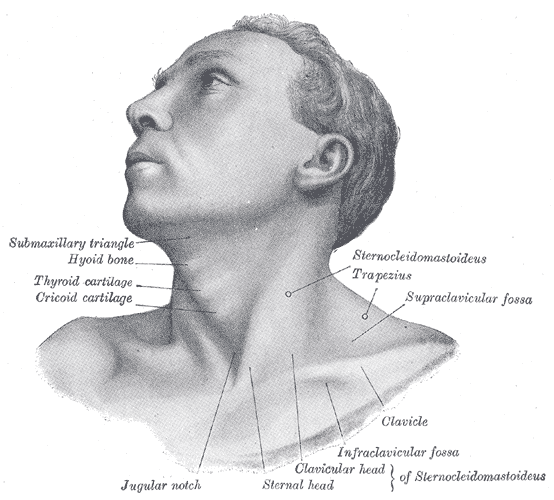
The neck from Grays Anatomy
The Neck
If Alexander had experienced problems in a different part of his body than his larynx, he might never have noticed a natural phenomenon:
That the movement of the head, via the neck, controls the movement of the rest of the body
and
That the quality of the neck, tense or relaxed affects the quality of the rest of the body.
It is your neck and the muscles in it that move your head. As anyone who has ridden a horse will know (and Alexander was a fine horseman…) you control a horse by controlling its head.
The neck from Grays Anatomy.
However, it is the eyes that guide the movement of the head via the neck muscles.
If you are standing and you see something or somewhere you want to move towards, your head moves subtly towards it first. This takes you out of balance so that your body starts to tip in that direction. This triggers a reflex which puts one or other foot out in that direction for you to move onto, after which your momentum and the continued desire of your head, keep you moving toward your objective. This results in walking, or if the desire is strong enough, running.
We also know that when someone senses danger, the muscles in the back of their neck tighten, rotating the head backwards. Immediately after this, muscles at the sides of the neck pull the head and neck down and forward. This is followed by reflexes which pull the shoulders forward, bend the torso forward and bend the knees. This has the effect of making the person a smaller target, closer to the ground and more likely to roll if they are knocked over. It also stores energy in their body, like a spring, which can be released and directed to hit out or run.
Unfortunately, there have been so many times when we sensed danger since early childhood, without any trigger to release the stored energy again, that our bodies have very gradually retained some of this tension each time. This is so gradual and subtle that we do not notice it developing. We do not even know we are holding tension.
This tension interferes with our reflexes, our freedom of movement and our natural poise or tendency to rise easily upright. Sometimes we fight this tension with extra effort and sometimes we surrender to it and end up slumped. Either way, our natural posture is undermined and distorted and our movement is distorted and impeded. Worse still, we develop habits to compensate for the tension, which are often difficult to let go of even if we manage to let go of the tension.
The traditional (non Alexander) way of combating all this is postural training and physical exercise. However, these actually compound the problems. They are an additional layer of extra effort on top of the tension and the compensatory habits that go with it. We need a way to undo the residual tension and then a way to put aside the habits that went with it, so as to allow our natural poise, posture and healthy reflexes and movement patterns to reemerge and reassert themselves.
In the Alexander Technique, we need to get rid of this background tension first.
Then we help you to bypass any habits that developed as a result of the tension.
Then, due to the ease with which your poise and natural reflexes move you, it seems we are not putting enough effort and control into what we are doing, therefore we coach you to trust this ease and freedom while you move, so that you no longer resort to the familiarity of your habits.
Relaxation

Deep relaxation. Felines are passmasters. It is easy to show here at rest, but deep relaxation while active is much more subtle to be able to see.
Alexander disliked the idea of relaxation. He observed that when people relaxed, it only lasted while they were inactive. It also did not improve what he called their use of themselves: they still had the same habits and distortions that they had before relaxing.
He did not seem to recognise or acknowledge the idea of residual tension. However, we can be pretty sure that when he observed people relaxing, they merely went from their normal active state on top of background tension, to a residual or plateau level of that tension.
This background tension is so pervasive among nearly all of us, that we do not see or recognise it in others and we are not aware of it in ourselves. The medical profession does not recognise it and therefore fails to account for it in the development of diseases.
I myself did not recognise it as a major factor for six years of having Alexander lessons and training as an Alexander teacher. It was only in my third and final year of training that I suddenly recognised its significance. On the same day, I experienced three things:
I saw a visiting teacher for the first time and he was visibly relaxed while walking. His shoulders gently rolled while he walked and unlike many teachers and pupils of the technique, he was not over projecting his head upward, but it was simply loosely floating, a bit like a balloon on a string, rising to its optimum height without effort. His whole body was relaxed and fluid.
Deep relaxation. Felines are passmasters. It is easy to show here at rest, but deep relaxation while active is much more subtle to be able to see.
Later a leading psychotherapist came in to give us a talk. He was pretty fluid and poised as well, presumably having resolved any issues that would have maintained and held tension, but without having learned the technique. He brought in with him, his two week old puppy. The puppy too was loose and floppy, especially when it lay down for you to pet it: you could simply waggle its shoulders around without any resistance. And when it was up, it was alert, poised for action, or bouncing and springing about. It had tone, but absolutely no tension.

And then the psychotherapist’s talk was about how all organisms, from single cell creatures to complex mammals such as ourselves, tense themselves when they sense danger.
It was then that it was patently clear to me that we needed to relax away this background tension before we could expect to bring about any real improvement in peoples’ movement, coordination, poise, posture and alignment, or their overall condition and function and especially before expecting any ailments to do with this background tension to resolve themselves.
In fairness, the technique as usually taught, does relax people below the background level of tension. This is achieved both by the work of easing you out on a massage table (with clothes on) and also during the guided movements and activities. Also, Alexander himself instructed people to free their necks and various other parts of their bodies (though without telling them how to.) However, the importance of this before expecting any improvements in other areas was never pointed out to me by my various teachers and teacher training instructors over the six previous years since I had my first lesson in the technique. I now openly prioritise this.
Thinking
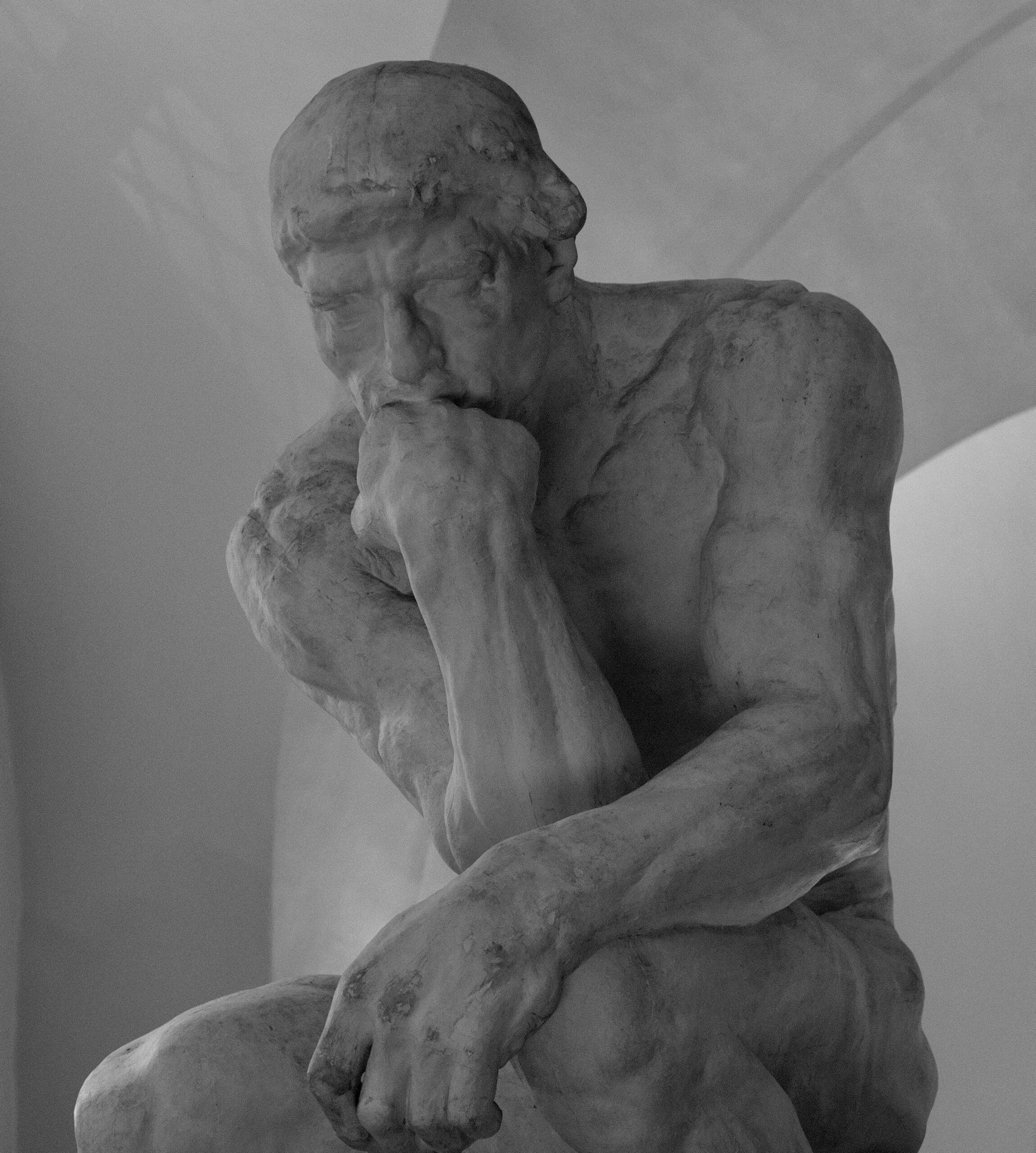
‘The Thinker’ Dresden, Germany.
No, not that sort of collapsed or stressed thinking, but being gently and clearly aware of the quality you want.
Although Alexander came up with the idea of directing various parts of his body, presumably meaning for him and us to intend that they go in that direction, without actually deliberately moving them, he did not describe what directing was in practical terms. Likewise, when he instructed people to free their necks or other parts of their bodies, he did not say how we should free them.
What we do know is that when we think of a position or a movement, there is a measurable physical difference as a result. For instance, if you think of moving a finger, but without actually moving it, electrical activity can be measured in the muscles that would move it. Or as one saying goes:
What you think is what you get
in terms of how your body works.
Furthermore, we know that muscles normally only contract or hold tension as a result of continuous nerve stimulation. This must obviously be coming from our brains, but with background tension, we do not know that our brains are sending these messages. By simply thinking of parts of us relaxing or realigning, we are actually changing the brain patterns that set up the tensions and distortions in the first place, so that these patterns gradually release.
It is true that these brain messages can be stopped by massage and triggering special organs in the muscles, but it is only temporary. We also know that muscles can only pull and cannot push. Trying to deliberately lengthen any part of us involves tightening one set of muscles to stretch another. Many techniques teach us to contract and tighten muscles and then let go of them, which may get them to relax more than they were before, but again, residual tension soon returns. So there is little we can do physically to relax our muscles long term.
However, if you think, but only think, of your neck being soft, calm and relaxed, it is likely to become a bit more relaxed. The idea is to think of it this way, whether it seems to be relaxing or not. This is the best way to free one’s neck, as Alexander would advise. Any attempt to make it relax will result in extra muscle tension, so you have to avoid that and accept whatever results you get. Even with a painful, stiff feeling neck, that does not seem to change by thinking, it is likely to subtly soften and relax over time with frequent, gentle thoughts of doing so.
Incidentally, similar to the tightening and relaxing above, just thinking of your neck (or any other part) tensing and then releasing may have quicker initial results, though just thinking of your neck being soft, calm and relaxed is far better in the long run.
Likewise, if you are distorted or slumped, thinking of the back of your head releasing away from the floor or from the rest of your body, will tend to release the muscles at the back of your neck that were rotating your head backwards. Better still, if you think of the back of your head already being released, it will tend to release it if it was contracted, and maintain the release if it wasn’t.
Also if you think of the rest of your head also rising away from the floor or away from the rest of your body, it will release the muscles at the sides of your neck and allow your head to rise and maintain optimum buoyancy. And thinking of that buoyancy as if it is lifting the rest of your body, will tend to draw your body up into alignment, whether you are sitting, standing or moving about.
This idea of thinking without doing anything directly, is new to most of us.
Avoid trying to feel if there has been a result. You may feel a change, but this has to be a result of the thought alone. You may not feel any change or anything at all, and yet the thinking on its own is the only long term effective way of bringing about these changes. It may even be bringing about changes without you realising or feeling anything.
Also avoid over-thinking: You actually need to have most of your attention on the outside world, on what you are doing and whatever else you are thinking. Just a quarter of a thought, or just being vaguely aware of the following thoughts is usually enough.
Think of your neck being soft, calm and relaxed
Think of the back of your head releasing away from the floor or the rest of your body
And thinking of the rest of your head also rising away from the floor,
as if it is buoyant and lifting your body into alignment
The same goes for Alexander’s three choices. The idea is to get into practice at being in good condition for whatever you want to do and then gently flow into whatever you choose. If you imagine being able to do this, it becomes easier. With practice, it is like a Zen state, a Buddhist state of non attachment, though “Without the candles or sitting cross legged” as one teacher puts it. Or it is a flow state or being in the groove or the zone, as experienced by some performers and sports people. Again, this is a way of thinking.
So, thinking achieves all of Alexander’s objectives: inhibition, direction and conscious choice.
‘The Thinker’ Dresden, Germany.
No, not that sort of collapsed or stressed thinking, but being gently and clearly aware of the quality you want.
I Teach Differently
If you are already familiar with the technique, you may notice that my descriptions differ from what you have been used to. My emphasis on getting rid of background tension and on thinking, both differ from the mainstream. My teaching methods, while staying true to the spirit of Alexander’s technique, are also different.
Many teachers take you through a series of manoeuvres, e.g. standing you up from and sitting you down in a chair, without explaining what they are doing or why, or especially what they expect from you. They are teaching you by repetition and they do not tell you what they are doing to avoid you trying to use your existing habits to do it for them. This system works, but it takes a lot of repetition and therefore a lot of time. By contrast, I am very clear in telling you what I am doing and why, but I am also very clear about what I want you to do. This varies, but is usually about how to avoid engaging your habits. I also use a lot of positive reinforcement: gentle compliments, when you have achieved something well, especially for the first few times in each case.
Many teachers will teach a series of directions. These are usually: “Neck free, head forward and up, back lengthen and widen.” These are the directions that Alexander used himself. However, his conditions were different from most of ours and his directions can be counterproductive and confusing to us. He was born premature, seemingly with underdeveloped lungs and had breathing difficulties throughout his early life. He was born in the Victorian era, when distorted ideas of ‘correct’ posture were far stronger than today. And he may have learned some misplaced ideas about increasing lung capacity and improving voice production as an actor. These would all lead to sticking his chest out by arching his back, and to pulling his head back to breath in. Few of us do this. Instead, not only do I emphasise thinking rather than directing, I specifically use the thinking sequence described earlier. This will both free your neck and also align you appropriately, completely independently of how you were previously.
Summary
The Alexander Technique uses a way of thinking to relax you below the plateau level that you think is relaxation. You then remain far more relaxed than usual, even when you are active or under pressure. The plateau level is due to residual tension that has gradually and silently built up since early childhood.
This relaxation in turn allows your natural poise and coordination to reassert themselves, which means that your body can align and move itself more easily, precisely and efficiently, without the interference of this background tension.
This in turn relieves pressure throughout your body, reducing wear and tear and allowing structures to heal that had suffered under the tension.
The freedom from background tension also leads to a clearer mind and allows you to be more lively and alert, improving your attention to your surroundings. I coach you in optimising this, a sort of practical mindfulness. Combined with freedom and ease of movement and greater poise, it makes you feel more confident and generally better in yourself and the specific thinking techniques lead to better decision making.
Are you ready to have Alexander lessons?
By now, you have a better idea of what the Alexander Technique is, and how it works.
It usually takes just ten lessons within ten weeks to learn it to the point that you can maintain its benefits for yourself without further input from a teacher. After four lessons within the first two week, you will have got rid of most of the background tension and you will be able to put aside your immediate habitual responses.
I then teach you how to trust your poise and coordination during various activities, so that they can align you and guide you healthily and safely throughout your everyday life. I also teach you Alexander’s method of pausing, ensuring optimum condition, and then making a fresh decision. This is the basis of making good decisions throughout your life. These lessons are once per week.
Finally, I space out your lessons so that you learn to rely on yourself instead of a teacher and can take on and apply the principles of the Technique for yourself. During this time, we can resolve any difficulties you may have been having, fine tune your application of the Technique, and apply it to specific applications and situations in your life. Afterwards, I am always available for dealing with new situations or if you want an occasional top up, but mostly, you will be self sufficient and able to maintain the benefits for yourself. You can go to my About Lessons page here for fuller details.
How to Book a Lesson
If you have any questions, would like to have a free introduction, or you even just want to go ahead and book some lessons– including the free introduction, then please call me on 07791 930028 at any reasonable time.
Remember, most people can learn what took me five years in just ten individual lessons for only £500– a massive saving in both time and money. Call me on 07791 930028 to get started in learning one of the most effective ways of improving and maximising the quality of your life!
Classes & Services

Individual Lessons
Individual attention for your individual needs.
The fastest way to learn.

Group Classes
Public drop-in classes for any level.
Bespoke clasesse for clubs, groups, choirs, orchestras etc.

Counselling Coaching NLP
Effective and enjoyable life enhancement.
Rapid and comfortable resolution of emotional issues.