
Loosen Up with the
Alexander Technique
Poise Presence Confidence and Aliveness
Free IntroductionDavid Owen +44 1752 361576 or 07791 930028
Over 35 years experience
A Maasai overlooks the Serengeti at sundown
Imagine yourself on the Serengeti!
We came from Africa. Wherever we were, we had to stay alert: aware of our surroundings from the ground beneath our feet– thorns, snakes, skorpions– to the horizon on all sides including behind, to the sky above. Aware of the scents, the wind and the weather, we had to have our eyes wide and our ears tuned for anything that might be useful or dangerous. But this would be our effortless natural state. We would also be relaxed, yet poised. And with poise comes a better sense of wellbeing and the wellbeing in turn promotes poise!
And what is this sense of wellbeing? I would claim it includes liveliness, clarity, confidence, a natural sense of joy, and the ability to be your full, true, authentic self. Our observation would be practical, non judgemental and in the moment, similar to practical mindfulness or Walking Zen. This would lead to open mindedness and making appropriate practical decisions in the moment.
This, including the state of Zen, is not an artificial, but a natural condition, far closer to animal consciousness than modern western human existence. Our two kittens are a good example: they are observant, fluid, spontaneous and playful. They know where and when food is, and they understand cause and effect, for instance, knowing by its sound, when the automatic cat flap is unlocked, but they show no signs of ruminating or judging. They are just in the moment all the time.
However, if this is natural, how is it that we cannot just easily be that way? It is in fact possible to achieve it with coaching for a short while, but difficult to maintain. Sports people, musicians and other performers often achieve it while they are engaged in their activity: there is no room for everyday mind wandering and they get in the groove, in the flow or in the zone. Meditation and mindfulness practices can get close, but they require taking time out from the world, require great dedication and take a long time. They may reduce background tension to a degree, though it is not specifically recognised or addressed. Yoga, Ti-chi or Chi-gong combine mindfulness with physical fluidity, but were not developed to deal with modern western conditions. I have encountered people with fluidity, openness and joy, who have had no Alexander work, but most have been through significant self development and therapy, resolving childhood and social conflicts, and most have done a fair bit of meditation, and again, it has taken a long, long time.
So what makes it difficult? I claim that it is Brain Fog!
Brain Fog
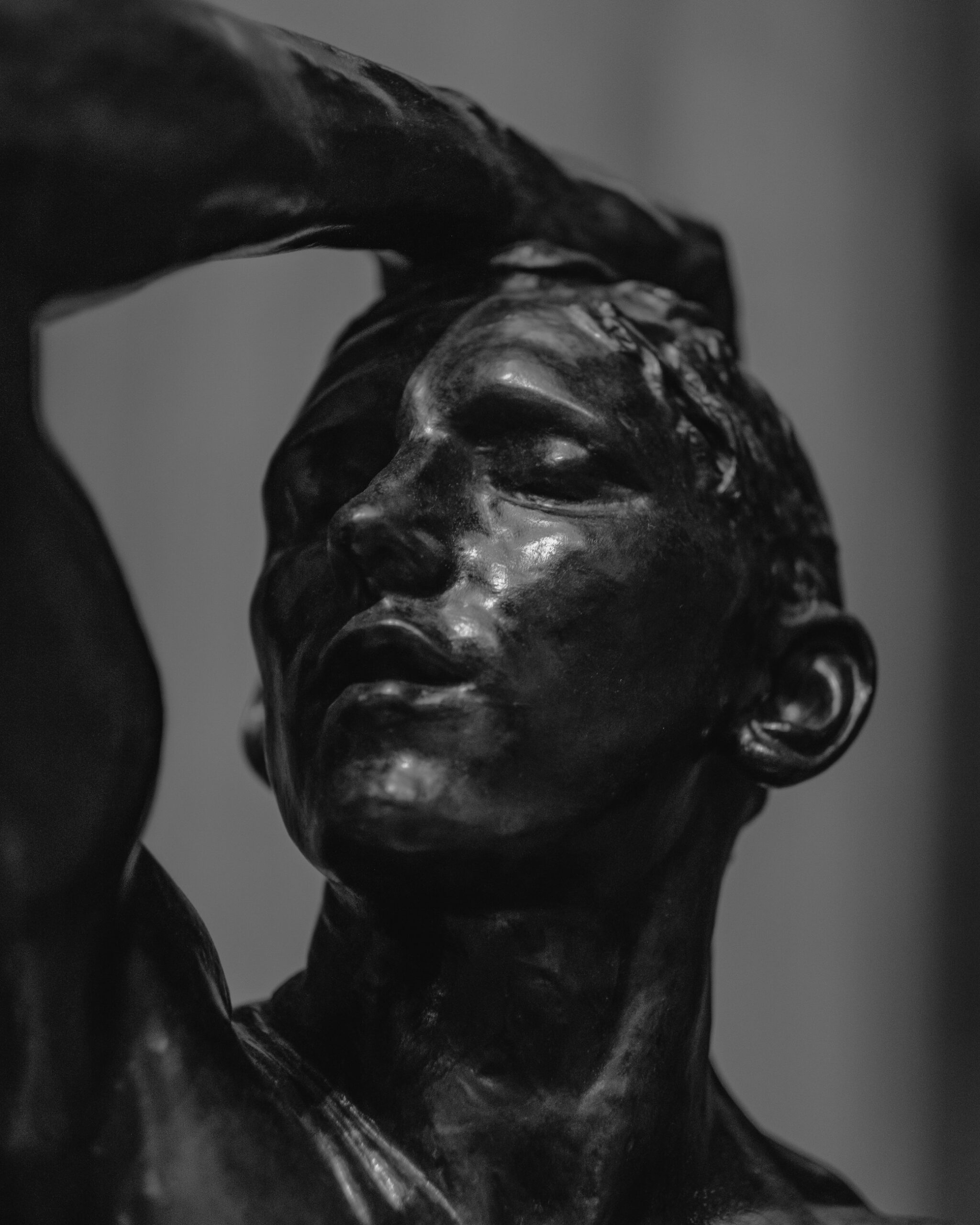
Age of Bronze by Auguste Rodin
Japan Museum
Brain fog will reduce your perception of and presence in the real world significantly. And by brain fog, I don’t just mean an inability to think clearly. I also mean the multitude of internal thoughts and distractions that take up our thinking capacity most of the time. Our lives and our conditions are far from natural and our minds have not adapted to these unnatural conditions.
Causes of Brain Fog
There are many causes of brain fog, which more naturally living people have much less of. These fall into two main groups: Mental and emotional, and physical.
Mental causes:
-
- Pressures of modern life- bills and obligations
- Contradictory social and moral expectations – shoulds etc
- False expectations and comparisons with others, leading to envy or feelings of inadequacy
- Too much introspection
- Fears, worries and rumination
- Resultant unresolved persistent negative emotions
- Physical distractions such as smartphones or adverts
Physical causes:
-
- Unconscious physical background tension from childhood and from all of the above
- Noticeable physical tension
- Extra effort & discomfort due to unconscious or noticeable tension
Mental Causes
Contradictions

La comédie humaine
Musée d’Orsay, Paris
Many of the mental causes are interlinked. The pressures of modern life require most of us to get a ‘job’ in order to afford somewhere decent to live, feed and clothe ourselves, have a decent lifestyle and be able to support children or loved ones. Few people have the luxury of doing something they love. Even fewer get to choose their own terms or hours. We are obliged to subjugate our lives in order to fulfil our needs. This causes inner conflict and takes up valuable attention.
We have grown up in a society that has a myriad of social rules and expectations, most of which conflict with what we might naturally want to do. It is not that more naturally living societies do not have any of these, but they are usually practical and obvious. I know of some rules in these societies that were based in superstition, yet they were still rooted in practicality, such as the prevention of disease. When you know why you should or shouldn’t do something, it is a lot easier to comply happily with it. Otherwise, these contradictions lead to frustration and uneasiness, again distractions from our valuable attention.
Also, contradictions such as ‘I should or must,’ when I don’t want to, or ‘I shouldn’t or must not,’ while I want to, set up opposing muscular patterns. Whatever we think is reflected in our bodies: If you so much as think of moving a finger, electrical impulses can be measured in the muscles that would move it, even if the finger does not visibly move. So thinking two contradictory thoughts at the same time, causes two opposing muscular patterns, causing tension, which as we will soon see, also causes brain fog.
False expectations also distract us from real life. For a long time, I disliked the Buddhist principle of non attachment. I had many desires and very few attainments of them. I believe that having clear goals and desires is essential to a healthy life, but envy and comparing yourself with others is mentally unhealthy, and again, distracts from appreciating what we have already got.
La comédie humaine
Musée d’Orsay, Paris
Over Thinking
Introspection is a good thing in moderation, but western society has developed a fetish with identity, knowing who you are or ‘finding yourself.’ Richard Bandler, the originator of NLP™ Tells a story of a leading psychiatrist who went to India to ‘Find himself.’ On the psychiatrist’s return, Bandler asked him if he had found himself, to which he replied that he had not really. “Well– you’re right here!” claimed Bandler. When we are in the present, there is no issue of who we are, we just are. In fact, when people are in the zone, in the flow or in the groove, they report afterwards that it was as if they weren’t actually there, or they became the activity, or often more to the point, not in its way. This is exemplified in the books The Inner Game of Tennis by W. Timothy Gallwey and Zen in the Art of Archery by Eugen Herrigel.
We do obviously need to think, and we do need to solve problems. Unfortunately, when we can’t find a solution to a problem, we often chase it round and round, or maybe it chases us around our minds, like a dog worrying sheep and chasing them around a field. This distracts us from the outside world. Often we need to look at the situation from another point of view, as if we were a neutral outsider, to see possible solutions. At other times, we need to know when to stop and just accept that we cannot solve it for the moment, as exemplified by the so called Serenity Prayer:
Give me the courage to change those things I can change,
The serenity to accept what I cannot change,
And the wisdom to know the difference!
It is knowing the difference, knowing when to stop trying, that can be the tricky bit. There are times when we could do something, but the effort or cost to us might be too much. And there are times when we know we probably can’t change something, but would not feel good with ourselves if we did not attempt it. Lack of background tension can lead to more inner peace, and that can help to clarify these situations far more easily.
Of course, unresolved problems, impositions and dissatisfaction lead to so called negative emotions. I say so called: our emotions are meant to move us on to find solutions and put them into practice– they are designed to get us to do something– i.e. to get us into ‘motion.’ Depression is actually meant to make us feel bad enough to change something. Anger also gives us energy and motivation to move and deal with things. Again, if we can clearly see that there is no immediate solution, then if we are already calmer in ourselves, it is easier to have that serenity to accept them, at least until a solution becomes possible. Unfortunately, if we have background tension, it is more difficult to asses whether we can resolve a problem, and so not only do we keep going round and round in our minds, but the emotions themselves become more and more distracting and pull us further and further away from being present in the real world. This in turn makes us less and less likely to recognise opportunities to resolve our problems, and so there is a worsening cycle.
In modern life there are also many physical distractions. Smartphones with social apps, the internet in general, TV, and also advertisements on all these and on hoardings all over the place. All these are designed especially to grab your attention, and while some of it is useful, or sometimes nearly essential, there is a strong risk of them diverting our awareness away from the real world.
Physical Causes of Brain Fog
Unenforced Rules

Rules!
The main, unconscious and unrecognised physical cause of brain fog is background tension. Background tension arises in many ways, but principally during childhood because rules that are imposed by parents and adults are not properly administered, leading the child to test the boundaries, but feel fear of punishment, which often does not come, triggering a slow version of the startle response.
The startle response is a natural set of reflexes that retract the head and curl up the body, making it a smaller target to an attacker and meaning you are closer to the ground and will roll, rather than slam down like a tree trunk if you are knocked over. It also stores energy in your body, like a spring, ready to release into fighting back or running away. When we fear punishment, we tend to cower, but when it never comes, there is no trigger to release the contractions. Although after each incident we may relax gradually, over time, we build up more and more residual tension from it. This contraction sequence also occurs from mental and emotional conflicts, from fears and doubts and contradictions during adult life, and again, is mostly unresolved, leading to more, very gradually increasing background tension.
Stored Energy

Neck and body contraction can be released to lift a heavy load.
This energy storing action is also used naturally in preparation for heavy lifting or pushing, so that more energy can be applied. Unfortunately, most of what we think of as ‘Hard work’ or even ‘Thinking hard’ triggers the same contraction, but because there is often very little physical effort involved, there is nothing to trigger the release of that contraction and energy, and so, background tension builds further.
Furthermore, ‘Thinking hard’ or ‘Concentrating’ gets many of us to tighten our jaw muscles and our scalp muscles in our foreheads and at the back of the skull. Over time, this is what causes a furrowed brow. The tension gives a sensation of pressure in our heads, which only tricks us into believing we are making a concerted effort to think. In fact, this effort and the sensations it produces are a distraction from thinking clearly. In fact, the act of thinking has no physical sensation and can best be achieved with a calm mind and relaxed body.
To slightly misquote Salvador Dali:
“Where thinking is concerned, nothing is ever difficult.
You can either do it, or you cannot.”
But how does tension, especially unconscious, unnoticed background tension cause brain fog?
How Tension Causes Brain Fog
The answer is that muscles only contract or hold tension as a result of continuous nerve stimulation. This must obviously be coming from our brains, but with background tension, we do not know that our brains are sending these messages. The tense muscles and all the parts that are strained or compressed as a result of the tension, then send a stream of nerve impulses back to your brain. Of course, we are usually unaware of all this, as not only is the sending of the messages unconscious, but the receiving of them is edited out if they are not new, just like an editing office that is only looking for ‘News’ (plural of New!) Notice that you were probably unaware of the sensations of your clothing or footwear until now, unless they were new sensations. So the editing office is busy rejecting messages. This means that your brain is busy sending tension messages, part of it is receiving a torrent of feedback from the tension and part is busy editing out most of the messages from your conscious mind, giving your brain even more work to do.
When we feel actual stress, it means that the editing capacity has been exceeded and the sensations of tension have broken through to conscious awareness. Of course we can take pain killers, beta-blockers and tranquilisers. We can go on retreat or have a massage, but it does not deal with underlying causes. More to the point, this is now a major distraction from being present in the world.
Also, when your muscles are tense, it takes extra effort to perform the same functions and the extra effort distorts the movement, so your brain has to correct for these distortions. Furthermore, we usually feel that performing these functions takes effort and this in turn may be discouraging. So your brain has to do extra work in initiating the extra effort, in registering distortions, correcting the distortions and registering the sense of extra effort and possibly fatigue, and then has to deal with the mental dissatisfaction that this may cause.
Furthermore, when you are tense, your brain thinks you are in at least some degree of danger– otherwise, why would you be tense? (Our brains often use circular logic!) And when your brain thinks you are in danger, it drains blood from the cerebral cortex, the logical and most recently developed part of your brain. Instead, it diverts the blood to the deeper, more ancient and basic parts of your brain that deal with basic functions and with fight and flight. All this makes us less logical and more reactive, rather than responsive, and leads to further brain fog and confusion.
Why Can’t I Feel Background Tension?
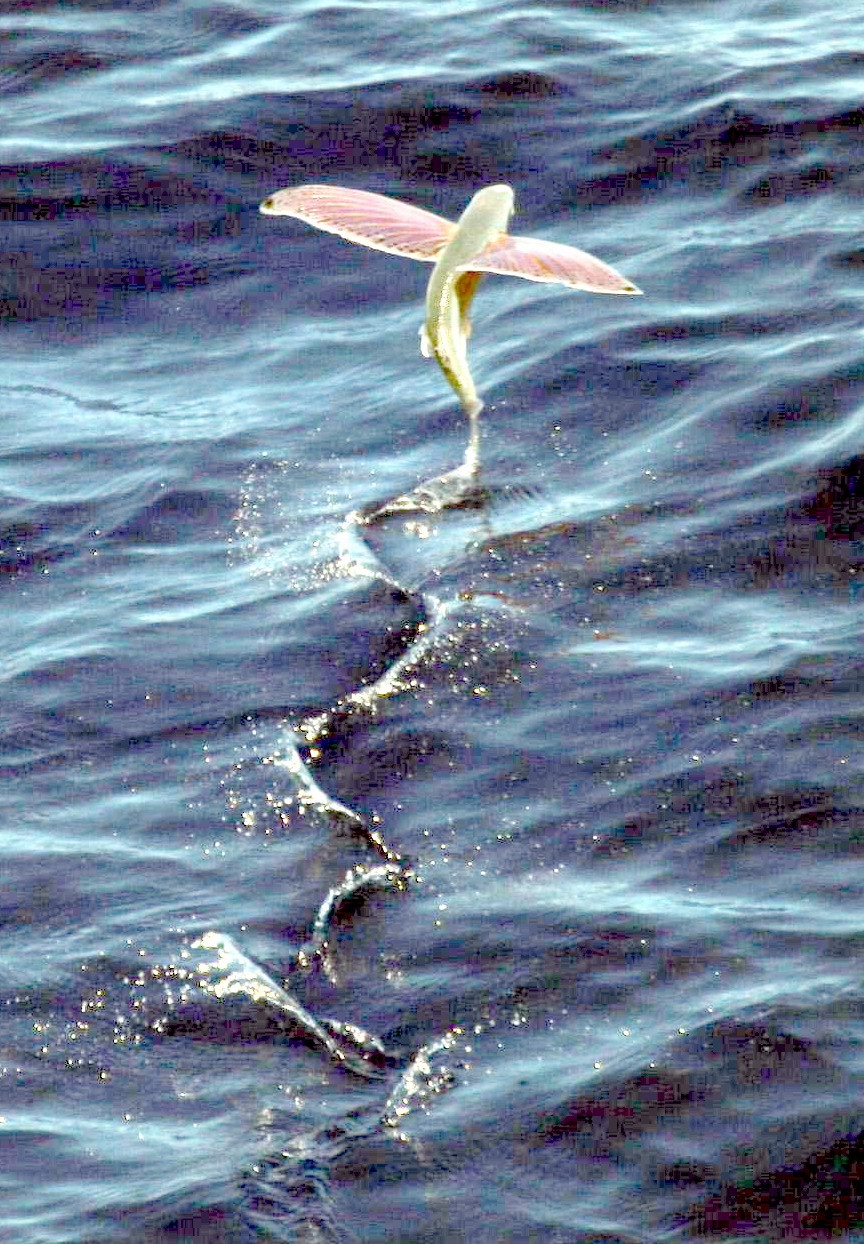
A flying fish taking off.
Only a fish that has been out of water, knows what water is!
“I don’t have background tension” I hear some people say. “If I’ve got all this background tension, why cant i feel it?” Most people are either blissfully or sometimes painfully unaware of how much tension they are holding. My mother, towards the end of her life, invited me to do a little Alexander work with her. I gently cradled her head and tried to gently get it to release and glide around. She eventually moved it herself when she became aware of my attempts, but otherwise, it was like rock. “There you are son” she said “It’s completely relaxed!” I did not have the heart to disillusion her.
Water to a Fish
One way of thinking about this is that it is ‘like water to a fish.’ Fish are born in water, they swim in it and it totally shapes their lives, but unless they are flying fish or have been out of the water, they do not know the difference between water and not water. Likewise, we do not know we were holding tension until we start to let go of it. Many people do not even feel their neck beginning to release while I am working with them, but as I work to release their arm, they are surprised at how much it lengthens. It is then that they realise that they must have been holding it.
Boiled Frog
Of course, we are not born in tension, but it builds up very gradually during our lives. You are probably familiar with the concept of the ‘Boiled Frog.’ This concept (cruel, and probably false) goes something like this:
You put a frog in a pan of cold water and it is happy there.
You put the pan on a very low heat, so that the pan warms up, but just ever so gently.
After a while, the water gets a little warm and the frog feels a little frisky and has a little swim around.
The water gets a little warmer and the frog feels warm, comfortable and sleepy.
The water gets warmer still and the frog falls asleep.
In reality, the frog would probably get warning signals as the water gets even hotter and try to jump out of the pan. In the mythical example it doesn’t and is eventually boiled.
Our tension has built up so slowly, that we just don’t notice it until eventually, it gets so bad that we actually feel the stiffness, often fatigue or even pain.

Mile High City
The Denver skyline looking towards the Rockies.
Mile High City

Mile High City
The Denver skyline looking towards the Rockies.
Another example is when I travelled from San Francisco at sea level, to Denver, which is a mile above sea level on the east side of the Rocky Mountains. I traveled by train over a period of a day and a half. Denver is actually called Mile High City! I of course, knew it was a mile high but noticed no difference until I started to walk up a slight gradient and started to get out of breath and felt fatigued. There just isn’t as much oxygen up there, and unless your system has got used to it, you run out of energy quite quickly. Conditions had changed, but I was physically unaware of the change until something brought it to my attention.
Neck Tension
I already mentioned that more or less constant sensations get filtered out by the editing department of the brain. However, if your neck is stiff, due to unreleased startle pattern contraction, it actually partially anaesthetises your body even more. It seems that the nerve impulses from your stiff neck, block up the editing department, and while it is busy filtering these sensations out, it just completely throws out any other general ongoing sensations from the rest of your body. So all we notice most of the time are the new and changing sensations from our body. This is a similar principle to a tens machine, which puts an eclectic current into you, which again, seems to distract the editing department and cause it to simply jettison any other sensation, such as pain, that is not changing much.
Brain Fog Distracts
Finally, we don’t notice it because we have so much going on in our minds so much of the time, causing brain fog as above.This means that we are often completely unaware of our sensations.
Greater Sensitivity
The Flip Side
Incidentally, the flip side of all this filtering out of sensations and being semi-anaesthetised, is that once you have let go of background tension, you become much more physically sensitive. This could seem a disadvantage: you will sense tension and even slight pain a lot more readily, but this is actually a good thing. Sensing even slight tension gives you feedback as to when you need to let go of it. Even slight pain helps you to stop doing what is causing it, or to look after the painful part if it has been damaged. Our generally dumbed down sensations while we have background tension leave us quite vulnerable to misusing ourselves and damaging ourselves.
Greater Pleasure

Better still, we become far more sensitive to pleasurable sensations. In fact my experience was that all the senses become much more sensitive. Tastes and smells, and my hearing became much more acute, noticing the sounds of birds’ wings overhead during my first year of training as a teacher. Visual acuity also improved as I noticed far more in peripheral vision and did not have to stare, but just take details in. And back to sensations, many people have confided that their love life has improved as a result of the Technique!

The Remedy
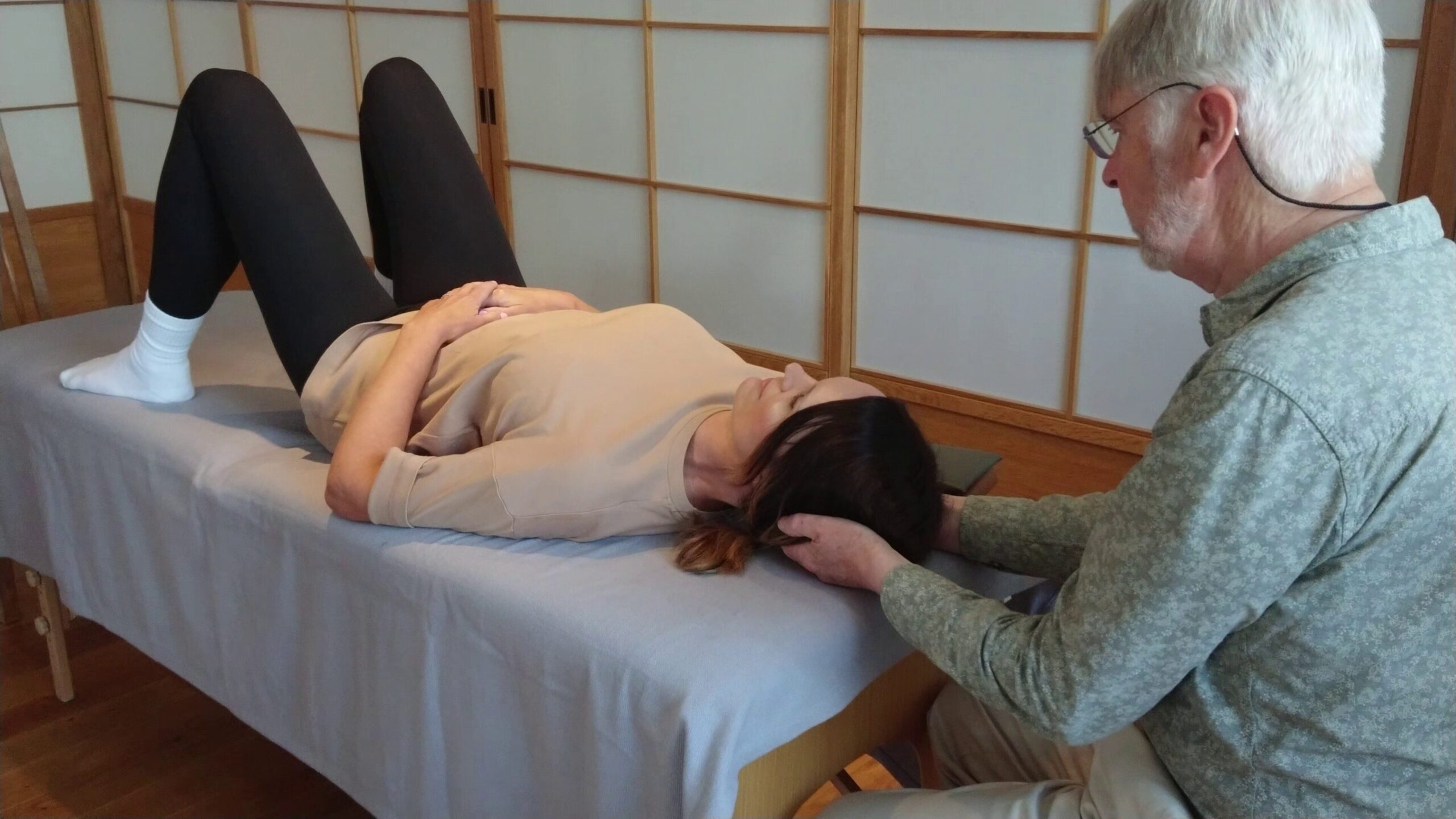
Easing out a lady’s head and neck: The first stage of release and relaxation.
Let Go of Tension
The first thing you need to get back to your natural state, is to be able to let go of and eliminate residual background tension. For this, I teach you how to think, for instance of your neck being soft, calm and relaxed, and to think of other parts releasing and relaxing. At the same time, I give people ‘Table Work’ where they lie on their back, knees usually up, and fully clothed on a massage table and while I support the back of their head and their neck with my hands, I think of their neck being soft calm and relaxed as I also gently instruct them to think of the same ideas. Their mind starts to reduce the tension impulsed to the muscles, and my thoughts transmit to my hands, where it is as if my hands can pass on the message to the person’s neck and head. I continue this principle, releasing their arms and legs and via these, it indirectly releases the muscles in the chest, abdomen and back. I devote a major part of four sessions in quick succession to this release work as the foundation for all the rest of the work.
Easing out a lady’s head and neck: The first stage of release and relaxation.
As mentioned, once the background tension has gone, we become far more sensitive in all our senses, both protecting us and allowing us to enjoy much more pleasure.
I have taught people how to work on each other to release this tension, which is the next most effective way of achieving it, compared to working with a teacher. I am also studying how some teachers taught this via video over internet during lockdown, with the eventual aim of not only teaching this remotely, but also by self paced personal learning– my eventual aim is for people to not need an Alexander Teacher at all to learn this stage. However, learning with a teacher is always going to be the quickest, easiest, most effective way.

Seen one of these recently? Probably not as they have been extinct for over 8000 years! Bronze sculpture of a Sabre-tooth Tiger or Smilodon, by Erich Oehme in the Tierpark, Berlin. Credit cc Lotse, Wikimedia.
Learn that you are Safe
Seen one of these recently? Probably not as they have been extinct for over 8000 years! Bronze sculpture of a Sabre-tooth Tiger or Smilodon, by Erich Oehme in the Tierpark, Berlin. Credit cc Lotse, Wikimedia.
In order to stay relaxed and prevent the tension creeping back, you need to recognise and learn that most of the time, you are safe. With my pupils, I usually ask them, once they are already fairly relaxed “Have you seen any sabre-toothed tigers or marauding Vikings recently?” (Sculptures, stuffed tigers and Viking reenactors do not count.) Sometimes I will lead them to a window and have them look up and down the street to check and confirm that there are none. This may seem a bit silly, but our unconscious minds developed to deal with pre Stone Age conditions, and they need to be updated to register that for the most part we are safer than we have ever been. It is this kind of pantomime move that gets through to the deeper parts of us and gets us to re-synchronise with current conditions. It is only once we can recognise that we are physically safe most of the time, that we can stay relaxed and also not tense and contract in response to non physical demands and non physical so called threats.
This is also an introduction to the same alertness that we would have had on the Serengeti or as a pre Stone Age person. Relaxation allows for better, clearer and easier observation. Clearer and easier observation leads to knowing when we are actually physically safe. And knowing we are safe leads to gently sustained relaxation.
Learn to Not Do
We cannot change until we can refrain from doing what we ordinarily would have done. Until then, we think we have choice, but those choices are limited by the sort of choices we always make. We are like the needle stuck in the groove of a broken vinyl record: we keep repeating the same so called choices over and over again.
When I am working with someone on a table, I will start to lift one of their arms and they will habitually start to lift it themselves. When I ask them if they noticed that they were lifting their arm, they usually realise that they were, but hadn’t noticed at the time. Sometimes they do not realise they were helping and I can carefully leave their arm suspended where they have raised it, at which point they realise that they must have raised it, otherwise it would just flop down again. All this is done very jovially and lightheartedly: I want my pupil to experience this, not as criticism, but as a fun discovery.
Next I will start again and tell them that I am about to lift their arm, but that I want them to totally ignore me doing so and to “Leave all the work, and wait for me” or ambiguously to “Leave all the work and weight, for me.” Our minds will process both meanings of an ambiguity, so “wait for me” obviously means wait for me to lift your arm for you, and “leave the weight for me” means do not assist me.” It is a little confusing, but it actually helps my pupil to simply let me lift their arm without assistance. This is now where I explain that unless we can pause and not react, we will not be able to make changes, and then I use this principle frequently while I am working on them.
Alexander learned this principle when he was trying to remedy his voice problems. He found that he habitually pulled his head back in anticipation of reciting and this was distorting his larynx and causing his voice problems. He had to decide not to recite until he was in a good enough condition to do it properly, and then make a split decision whether to just continue maintaining his good condition, do something other than recite, or in that split second, without time for habitual anticipation and its habits, go ahead and recite anyway. The pause, is essential to clear one’s mind of preconceived ideas, to prevent jumping to conclusions and to avoid habitual responses. It leads with practice to an openness of mind, similar to Zen, where you observe nonjudgmentally, leave yourself open to new ideas and new possibilities and fresh decisions. Conclusions you come to and decisions you make under these conditions are likely to be better suited to the situation than those that most people would make.
Use your Reason
In 1910, Alexander wrote– IN CAPITALS that
“THE CONSCIOUS MIND MUST BE QUICKENED.”
(Man’s Supreme Inheritance Ch 4 Para 10. Quickened here does not mean to make it faster, but it is the old fashioned meaning to ‘Make more alive!’)
Alexander had to stop what he had been doing and work out the causes of his voice problems by himself. His doctors were unable to help him and no one else seemed to know what caused his problems. Having stopped, he then had to analyse what he was doing to cause his problems and eventually realised he was habitually and unwittingly doing something to himself while he was reciting. He then had to reason out ways to get round his habits and avoid his problems. He then had to make sure that he stuck to these new ways, or ‘means whereby’ as he called them, to get round his problems, otherwise he reverted to his old habits which had caused his problems. (Words in italics are Alexander’s own terms.)
Likewise, to make our own lives better, we sometimes need to stop and analyse or work out what we are doing and whether it is best for us or the situation. And if it is not, then to reason out our own new ways or ‘means whereby’ to improve the situation. Then we need to make sure that we stick to the new ways. Like Alexander, we need to be willing to stop, pause, inhibit, or put off our desire to do what we want until we know we can do it appropriately and then stay open to still not doing it, or in that split second, doing something else, especially if it is now more appropriate, or go ahead after all and do what you had first intended.
Also through the Alexander Technique, by pausing before we jump to conclusions about something, we open the possibility to look at situations differently. Then we can work out more thoroughly, what may be going on and reason out better responses to those situations. This goes for our own situations and relationships, other peoples’ points of view and preferences, and broader issues, both in our own countries and throughout the world.
Beware of anyone who is trying to whip up strong negative emotions– remember, these will drain blood from the logical part of your brain. Stop and step back from what they are saying. There are many powerful vested interests wanting to distract us from what is really happening in the world. By pausing, we give ourselves the opportunity to see beyond their misinformation and misdirection and come to more humane and mature conclusions and see situations for what they really are.
It Gets Easier
All this stopping and delaying, questioning how we are doing things, and working out how to deal with things better, seems like a lot of work. Maybe this is why the editor of “Harper’s New Monthly Magazine” in August 1857 writes:
There are men who will dare death for glory or for country, who could not dare scorn or contumely for the truth; and people generally would rather die than think. (1)
(This is the origin of the phrase normally attributed to Bertrand Russell in 1925. Contumely means criticism or insult.)
For most people, thinking for themselves seems daunting, especially when there are other people more than willing to tell you what to think. However, once you have got rid of background tension, learned that you are safe, so that the blood returns to the logical part of your brain, and you can patiently pause and give yourself time to think, then thinking for yourself becomes almost effortless, so much so that you hardly notice it. Also, rather than concentrating, as mentioned above, if you sit back or mentally stand back and ponder, perhaps with a bit of curiosity, then it is often a lot easier to realise what is or has been going on.
Interestingly, Alexander used mirrors much of the time to observe himself, and this is a similar process to imagining what our more social problems look like to other people. Often we can see solutions to other peoples’ problems when they cannot see them themselves. When we imagine looking back at ourselves from another person’s point of view, we often see solutions that were not obvious from our own perspective.
Mindfulness – Be Alert!
As Alexander teachers, we frequently direct our pupils to be aware of their surroundings with all their senses. We coach our pupils in opening up their peripheral vision and all round awareness, even of what is outside of their visual field. Although this would be normal in our natural state, we are not used to it and so we have to practise directing our awareness outside of ourselves to start with. This is a natural form of mindfulness, exemplified by the book Mindfulness in 3d – Alexander Technique for the 21st Century(2) by Alexander teacher Peter Nobes.(3) One of the best and easiest Alexander Technique books I have come across!
By learning the technique, we naturally become more aware, we naturally direct far more of our attention onto the outside world. And despite becoming far more internally aware and in control of our own bodies, this self awareness takes very little attention and mostly works in the background. In fact, I advise my pupils to give no more than a quarter of a thought to thinking their directions. With practice, once background tension has been eliminated, being in charge of our own condition becomes virtually automatic. Just like a plate spinner, once they have a few plates spinning they can almost forget about them. And I am sure the Maasai people on the Serengeti don’t have to think of their necks being relaxed or their heads being buoyant– they have this naturally from birth.
Additionally, although so much of our awareness is directed outside, it often makes our thinking clearer and easier, almost as if it is quieter and calmer on the inside much of the time. As mentioned, Alexander himself was very opposed to the idea of concentration: he saw it as making an undue effort to exclude the outside world. Also, the tension we often produce to convince ourselves that we are ‘Thinking hard’ gives your brain extra unnecessary work in producing the tension in the first place and in perceiving it. It distracts you from thinking and does not assist your brain in thinking at all! However, once we have eliminated background tension and we know that we are safe and we have a proper blood supply to the logical parts of our brain, our thinking becomes calm and easy and often just happens in the background, without taking much attention away from our outside awareness.



Smile!
As part of an exercise to restore natural breathing, Alexander discovered that he needed to raise his soft palette, i.e. the soft back upper part of his mouth, and he discovered that the best and easiest way to do that was to think of something amusing or pleasant and therefore smile.
Now, my understanding of more naturally living people, is that they smile a lot more than we do, even though their circumstances may often be a lot more challenging than ours! Just like children who more naturally play, laugh and have fun, this is a natural state that we can return to. The main things that make this possible are getting rid of background tension and brain fog. Once we have got rid of these, we feel lighter and we feel clearer and more light hearted. In fact, natural poise makes us feel more confident and happier in ourselves.

However, as we have mostly not been smiling as much as we naturally would have, it is worth practising it deliberately. By deliberately remembering to smile from time to time, we also trick ourselves into feeling better. This happens in two ways: One, because we are smiling, our brains assume there must be something to feel good about, as our brains use circular logic as mentioned before, so they then make us feel good anyway. Secondly, the muscles used for smiling produce a lot of endorphins when they are activated, which automatically makes us feel good. Then obviously, once we feel good, we are far more likely to smile!


Summary
By eliminating background tension and brain fog, and by being mindful and directing our awareness outside, so that we can confirm that we are physically safe in the here and now, we become a lot calmer and our thinking gets easier. And as we trust our natural coordination and buoyancy to stand us up optimally with natural poise, we feel more confident and joyful and more present in the world.
In other words, all of this is self reinforcing. We know that our state of mind and emotions affect our bodies. What few people realise is how powerfully our bodies affect our clarity, observation and presence in the world, as well as our sense of aliveness and confidence. Also our body language and state of mind affect other people, who are likely to feel more comfortable with us and respect us more.
How to Achieve These Benefits
“How can I achieve all this?” you may ask. The easiest way is to take one to one lessons with a qualified Alexander teacher. However, since qualifying myself, I have developed ways to teach you the Technique, that make it much easier to understand, and much quicker and easier to learn. As I have already made clear, I can teach what took me about five years to learn in around ten lessons over ten weeks.
All this can cost you as little as £500 for the whole course. This is about the equivalent of just a couple of cups of coffee per day. Incidentally, I have come across one day Mindfulness courses costing nearly £1300 online or £3000 for an in person group class– and there is no way they will facilitate reducing residual background tension. If my classes still seem like a bit of a stretch financially, I am happy to receive regular payments over a timescale that is realistic for you– get the work and improve your life when you want or need it– pay when you can afford it. You can go to my About Lessons page here for fuller details.
Book a Free Lesson
Please feel free to get in touch with me today on 07791 930028 and book your free introductory lesson. This could be the gateway to true natural mindfulness, alertness and aliveness, confidence, charisma and natural joy.
David Owen 07791 930028
(1) People generally would rather die than think https://quoteinvestigator.com/2018/09/23/think/
(2) Mindfulness in 3d https://www.alexandertech.co.uk/mindfulness-in-3d
(3) Peter Nobes https://www.alexandercentre.co.uk/
Be alert!
As one of my teachers would frequently say:
“Be alert!
Your country needs Lerts!”
With the Alexander Technique, you not only learn to be alert, you also become more alive as a result.

A Giraffe!
A giraffe on the Serengeti.
This is what Alert / A Lert looks like!
Note: He doesn’t have to constantly think of the buoyancy of his head or of it rising. His head just effortlessly rises and goes where he wants it to go.
Classes & Services

Individual Lessons
Individual attention for your individual needs.
The fastest way to learn.

Group Classes
Public drop-in classes for any level.
Bespoke clasesse for clubs, groups, choirs, orchestras etc.

Counselling Coaching NLP
Effective and enjoyable life enhancement.
Rapid and comfortable resolution of emotional issues.